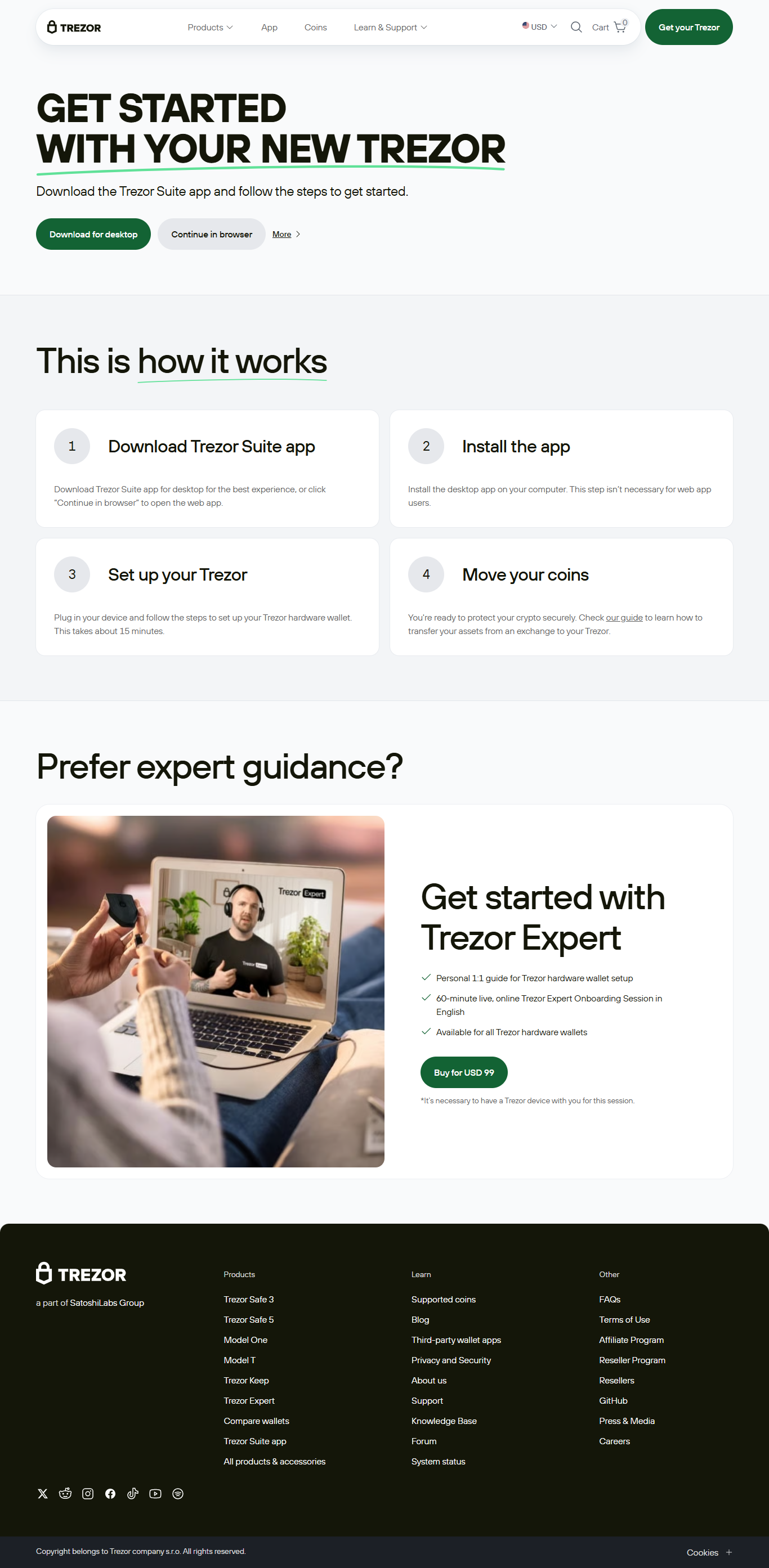
1. Why trezor.io/start is the Most Important URL You’ll Use
In the world of crypto, phishing is a constant threat. Malicious actors frequently create "lookalike" websites to trick users into entering their recovery seeds. trezor.io/start is the only verified gateway designed to prevent these attacks.
By visiting trezor.io/start, you ensure that:
Official Software: You are downloading the authentic trezor suite application directly from the source.
Firmware Verification: Your device is checked for authenticity using a Secure Element check.
Clean Slate: You are installing the most up-to-date firmware, ensuring no pre-installed malicious code exists on your device.
2. Navigating the Trezor Suite Ecosystem
Once you have initialized your device at trezor.io/start, you will be introduced to trezor suite. This is the primary software interface (available for Desktop, Web, and Mobile) that manages your private keys.
Key Features of Trezor Suite in 2026:
Portfolio Management: A comprehensive dashboard showing your balances across Bitcoin, Ethereum, Solana, and thousands of other tokens.
Privacy Tools: Advanced features like CoinJoin for Bitcoin anonymity and Tor integration to hide your IP address.
Native Staking: Directly stake assets like Ethereum or Solana to earn rewards without leaving the security of your cold storage.
Safe Exchanges: Buy, Sell, and Swap functionality integrated with verified third-party providers so you never have to risk a Trezor Login on a shady exchange.
3. Understanding the Trezor Bridge
During your setup or subsequent Trezor Login attempts, you might encounter a prompt regarding the trezor bridge.
Trezor bridge is a small but vital piece of communication software. Its primary job is to act as a translator between your physical hardware wallet and your computer’s web browser.
For Web Users: If you use the web-based version of the wallet, trezor bridge is mandatory. It runs in the background to facilitate the encrypted "handshake" between the device and the site.
For Desktop Users: The standalone trezor suite desktop app generally has the bridge functionality built-in, meaning you don't need to install it separately unless you are using third-party apps like MetaMask.
4. The Step-by-Step Trezor Login Process
A Trezor Login is not like logging into a social media account. You are not "signing in" to a server; you are unlocking the gateway to your private keys stored on the device.
Connect Your Device: Use the official USB cable to connect your Trezor to your computer.
Launch Trezor Suite: Open the app or navigate to the web portal via trezor.io/start.
The PIN Grid: Your Trezor device will display a scrambled 3x3 grid of numbers. On your computer, you will see a blank grid. You must click the dots on your computer that correspond to the numbers shown on your device. This ensures a keylogger cannot steal your PIN.
Enter Passphrase (Optional): If you have enabled a "Hidden Wallet," enter your passphrase. This "25th word" creates a completely separate set of accounts.
Verify on Device: Always check the device's physical screen to confirm the action.
5. Security Protocols: Recovery Seeds and Backups
During the trezor.io/start setup, the most important task is creating your recovery seed. In 2026, Trezor supports:
Standard Backup: A 12, 20, or 24-word phrase.
Shamir Backup: A more advanced method that allows you to split your recovery seed into multiple "shares," requiring a certain number of them to recover the wallet.
Crucial Warning: Never type these words into any computer, app, or website—even if it looks like a Trezor Login screen. Your Trezor device will only ever ask you to verify these words on its physical screen.
Final Thoughts
The path to financial freedom is paved with self-custody. By utilizing the official tools—starting at trezor.io/start, managing with trezor suite, and ensuring your trezor bridge is up to date—you are effectively removing the "middleman" from your finances. Remember that your Trezor is a fortress, but you are the gatekeeper. Stay vigilant, keep your software updated, and always verify every Trezor Login on the device itself.
FAQ (Frequently Asked Questions)
1. What do I do if trezor.io/start is not loading?
Check your internet connection and ensure you are not using a highly restrictive firewall. Always double-check the spelling to avoid phishing sites. If the site is down, you can still download trezor suite from the official GitHub repository.
2. Is the Trezor Bridge safe to install?
Yes, trezor bridge is a legitimate piece of software developed by SatoshiLabs. It does not have access to your private keys; it only facilitates the connection between the hardware and the software.
3. Can I use Trezor Suite on my phone?
Yes! Trezor Suite is available for Android (via USB) and iOS (for Trezor Safe 5 and 7 via Bluetooth, or view-only mode for older models).
4. What happens if I lose my Trezor device?
Your coins are not stored in the device; they are on the blockchain. As long as you have your recovery seed (created during the trezor.io/start setup), you can restore your wallet on a new Trezor or any compatible BIP-39 wallet.
5. Why is my Trezor Login failing?
Most login failures are caused by faulty USB cables, outdated trezor bridge versions, or incorrect PIN entries. Try a different cable or restart the trezor suite application.